




Sustainability
Since 2019, we have been recording our greenhouse gas emissions annually. Based on this assessment, we identify the main sources of emissions and develop measures to reduce them.
Corporate carbon footprint
Our climate strategy is based on the realisation that the effects of climate change are directly attributable to the amount of greenhouse gases released into the earth’s atmosphere. In order to determine our company’s greenhouse gas emissions holistically and in accordance with international standards, we analyse all relevant emission sources. This enables us to precisely identify and effectively reduce the main emissions for which we are responsible. When selecting the emission sources to be recognised in our corporate carbon footprint, we strictly adhere to the basic requirements of the Greenhouse Gas Protocol’s Corporate Accounting and Reporting Standard. This standard, developed by the World Business Council for Sustainable Development and the World Resources Institute, guarantees reproducible and transparent ecological accounting. It enables comparisons to be made over several financial years and with other companies:
The total emissions of our corporate carbon footprint for 2023 amount to 22,735.34 t CO2e, distributed across Scope 1, 2 and 3.
Introduction of the "Vytal" reusable system
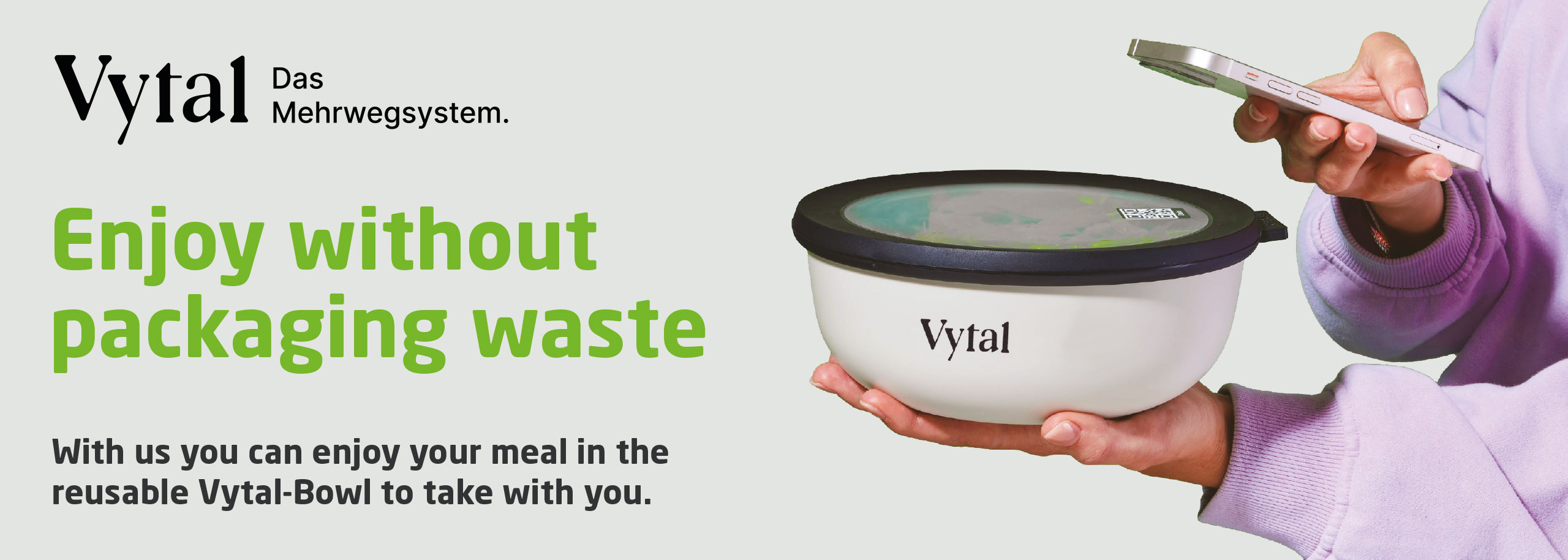
In line with the legal requirements for reusable packaging, the deposit-free Vytal reusable system was introduced in January 2023, allowing customers to take away meals in reusable containers instead of single-use packaging.
Cup to go®
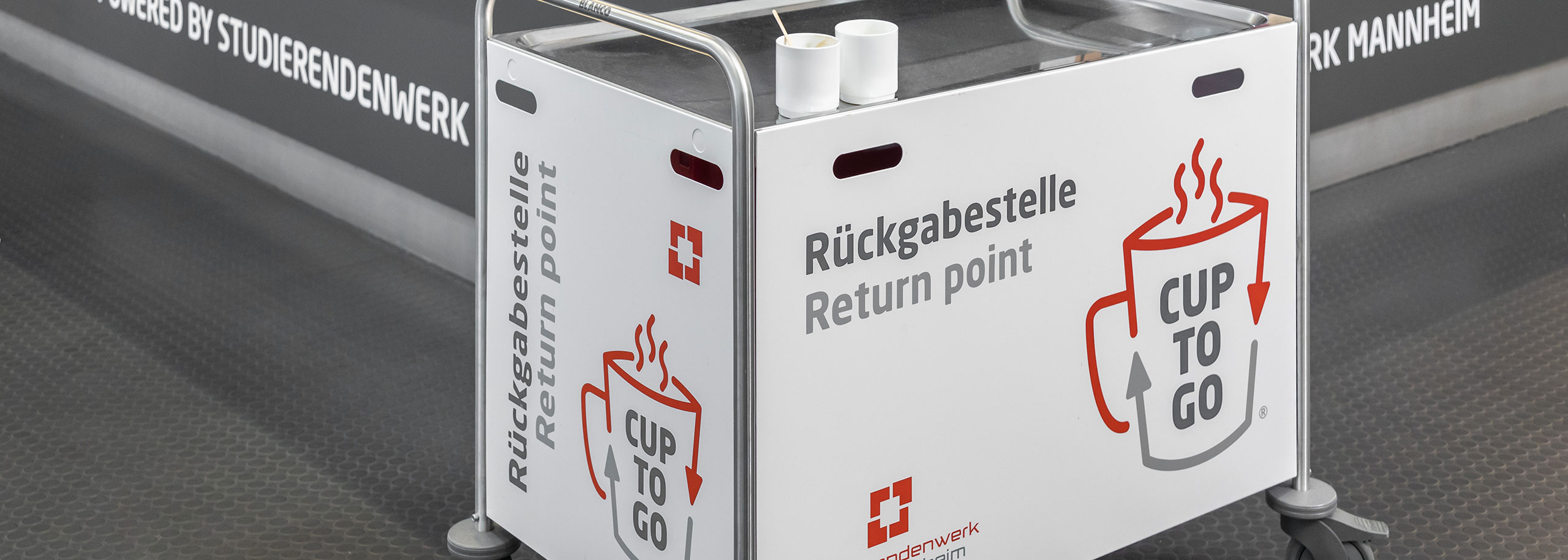
Reusable concept for canteens and cafeterias: reusable cups instead of disposable cups
Cup to Go® is an innovative sustainability concept that is based on user behaviour and thus intuitively replaces the use of disposable cups. The core element of the solution is the complete switch to reusable containers in the catering facilities operated by the Studierendenwerk at the University of Mannheim and Mannheim University of Applied Sciences. After use, the reusable cups can be returned to participating collection points and then used again.
The project development was preceded by a well-founded scientific analysis, which demonstrated an improvement in the ecological balance. As a result, the abolition of disposable cups and the switch to the Cup to Go® reusable system at Mannheim University of Applied Sciences can save 800 kg of CO2, 2,700 litres of water and 360 m²/a of natural space during a semester; at the University of Mannheim, savings of three times this amount can even be expected.
The current climate debate with increased ecological demands for sustainable consumption has long been a concern of the Studierendenwerk Mannheim. Among other things, this also concerns the flood of waste from disposable cups. In Germany, around 2.8 billion of these cups are thrown away every year, which equates to 40,000 tonnes of waste. Due to the plastic content in the cup, this waste has to be incinerated as residual waste. Tackling this challenge with Cup to Go® motivated Studierendenwerk Mannheim to apply for the City of Mannheim’s 2020 Environmental Award with its sustainability project. The focus of this year’s environmental award is the avoidance of plastic.
However, there are other reasons why it makes sense to banish disposable cups from coffee kitchens for good. For example, the raw materials required to manufacture disposable cups: 43,000 trees, 1.5 billion litres of water and 3,000 tonnes of crude oil are needed to produce the 2.8 billion cups, which also cause CO2 emissions of 111,000 tonnes per year.